Have you launched a chatbot, a resume screener, or an “auto” pricing tool and wondered if you also created a compliance job? AI slips into sales, support, HR, and finance. Buyers and regulators treat AI outputs like business decisions, even with a vendor tool.
This blog breaks down what to watch, what to document, and how to set guardrails that fit a lean team in the U.S., plus global rules that reach U.S. teams.
Why AI Regulatory Requirements Are Impacting SMB Workflows in 2026
AI influences access to work, credit, care, and education. It also shapes fraud reviews and eligibility decisions.
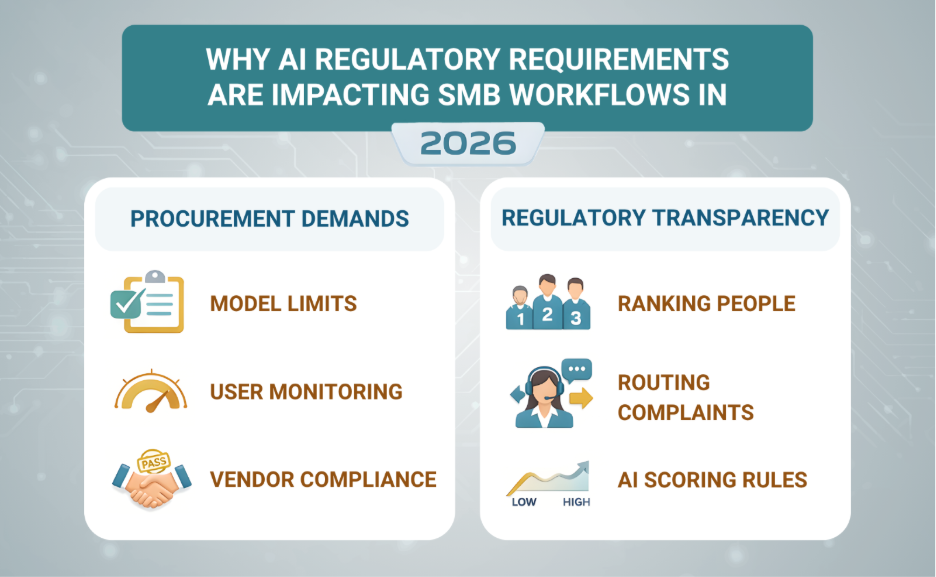
Procurement teams ask for proof before they approve AI vendors. They want model limits, testing notes, and user notices. That pressure drives SMB AI compliance even if you never get a formal inquiry.
Regulators also push transparency and accountability. Basic automations can trigger AI transparency requirements when they rank people, route complaints, or score risk. That is why Small business AI laws connect to product work, HR workflows, and support scripts.
Key AI Rules SMBs Need on Their Radar
AI rules no longer sit only with large enterprises or major tech firms. Small and midsize businesses now face direct pressure from state laws, privacy regulators, customers, and cross-border standards when they use AI in daily operations.
Before you deploy new tools or expand existing ones, you need a clear view of the main regulatory layers that can affect your workflows, disclosures, and internal controls.
1. U.S. AI Regulations for SMBs
In 2025, the Federal Trade Commission (FTC) published a 2025 AI Compliance Plan focused on transparency, accountability, and risk-based management, and many SMB teams use it as a checklist for rollout decisions.
For operations, the NIST AI Risk Management Framework (AI RMF 1.0) uses four functions: Map, Measure, Manage, Govern. If you align controls to it, you strengthen AI governance for SMB with a clear operating model.
State action lands early in hiring tools, consumer-facing disclosures, and safety reporting. Track State-level AI laws for small businesses where you sell, hire, or store data, then tie the rules to your release calendar.
2. EU AI Act Requirements for SMBs
You can sit in the U.S. and still face the EU AI Act when you sell into the EU, serve EU users, or support an EU customer through a partner. The Act uses risk tiers: unacceptable, high-risk, limited, minimal.
EU AI Act SMB requirements often show up through use cases. Hiring, credit scoring, education access, and parts of healthcare can fall into high risk. That triggers High-risk AI systems compliance with technical files, human oversight, and post-market monitoring.
Limited-risk tools still require notices and user transparency. That is also part of EU AI Act SMB requirements. AI risk classifications under EU AI Act decide the paperwork weight, so your inventory work becomes your first compliance asset.
3. Global AI Rules Affecting SMBs
OECD AI principles shape national guidance across many countries. ISO/IEC standards add structure, with ISO/IEC 42001:2023 for AI management systems and ISO/IEC 23894:2023 for AI risk management. You can adopt pieces without certification, and that still supports SMB AI compliance when customers ask for due diligence evidence.
Canada’s AIDA and Singapore’s governance model both push vendors toward stronger disclosures, documentation, and audit trails.
4. Data Privacy and Responsible AI Rules
AI governance sits on privacy and ethics. If you run a privacy program, you already own key controls: data maps, retention, access, and incident response.
Start with Data privacy regulations for SMB across state privacy laws and global rules such as GDPR. Then connect them to Ethical AI regulations that focus on discrimination and human review in workplace and consumer contexts.
You also need a policy that tells users when AI participates in an interaction. That links to AI transparency requirements and supports trust.
How SMBs Can Prepare for AI Regulatory Compliance
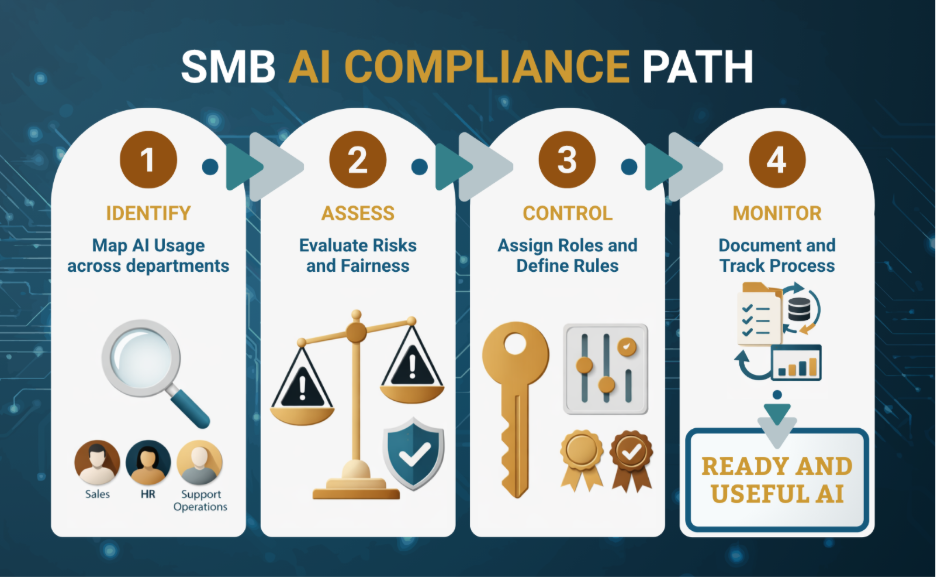
As AI use spreads across sales, HR, support, and operations, compliance can no longer sit with legal alone. SMBs need a practical system that shows where AI is used, what risks it creates, and who owns each control. The goal is simple: build a process that keeps AI useful, documented, and ready for changing regulatory checks.
Building an AI Inventory & Risk Map
Your first deliverable is an inventory of every AI feature and AI-enabled workflow. Include in-house models, third-party APIs, embedded AI in SaaS tools, and any automation that scores, ranks, or recommends.
Assign an owner to each item and capture: purpose, users, data inputs, decision impact, vendor, version, and human review path. This supports how SMBs can comply with AI laws because it turns rules into a list you can manage.
Use a light risk map:
- Minimal: internal drafting tools and internal search with no customer impact.
- Limited: chatbots and decision support that route to a human.
- High impact: hiring, credit, healthcare, education access, identity checks, and safety systems.
Also tag anything that can fall under High-risk AI systems compliance later, so you can scale controls with your roadmap.
Implementing Documentation, Monitoring & Disclosures
Treat documentation as a living file: what the system does, what data it uses, what tests you run, and how you handle drift, appeals, and complaints. This is where AI documentation requirements for SMBs become shared work across product, security, and operations.
In March 2026, the U.S. House passed the Small Business AI Advancement Act (H.R. 3679), a bipartisan law designed to help SMBs adopt AI with guidance, resources, and frameworks tailored to smaller enterprises.
Here is a practical AI regulatory readiness checklist for SMBs you can run during rollout.
| Control area | What to capture | Owner | Review |
| Use case scope | What the system does and does not do | Product | Each release |
| Data map | Inputs, retention, access controls | Security/IT | Quarterly |
| Model notes | Vendor version, limits, prompt rules | Engineering | Each update |
| Tests | Bias checks, accuracy checks, failure cases | QA + Ops | Each change |
| Human review | Overrides, escalation, appeals | Ops lead | Monthly |
| Notices | AI system disclosure obligations for SMB in UI and policies | Legal + Product | Each release |
| Monitoring | Drift signals, abuse signals, incident triggers | Security | Weekly |
At Consltek, we build this as a blueprint. We map each AI use case to ownership, data flow, and a small control pack that fits lean IT teams, with one view of risk.
- Blueprint-led rollout with clear owners
- Vendor evidence checks tied to renewals
Creating an AI Governance Framework
Governance means roles, guardrails, and decision rights. Keep it light, but keep it consistent.
Build your AI governance frameworks for small businesses around NIST and ISO pieces. Name an AI owner per system, set “no-go” patterns, add a review path for sensitive data, and extend incident response to cover drift and misuse. This is the core of AI governance for SMB.
At Consltek, we align governance to the cadence teams use for security and uptime, so it stays usable.
Common Compliance Slip-Ups SMBs Can Prevent
Start with state tracking. Build a tracker for State-specific AI rules for SMBs in 2026 and tie it to HR tool changes and product releases. This also keeps you aligned with State-level AI laws for small businesses.
Keep privacy and ethics tied to AI. When you map Data privacy regulations for SMB to your inventory, you avoid duplicate controls. When you apply Ethical AI regulations to hiring and customer workflows, you keep review cycles smooth.
Keep disclosures consistent across pages and scripts.
Watch vendor geography too. California enacted the Transparency in Frontier AI Act (SB 53) in 2025 and requires developers to disclose safety and risk-mitigation measures for frontier AI systems, so confirm what your vendors disclose when their AI runs from California-based providers.
AI Compliance Is Now a Business Advantage for SMBs
AI regulations are no longer something small and mid-sized businesses can ignore. If your team uses chatbots, screening tools, pricing automation, or AI-powered workflows in daily operations, compliance needs to become part of the process. The good news is that getting ready does not have to mean building a heavy legal program. A clear inventory, simple risk checks, documented controls, and honest disclosures can go a long way.
Businesses that act early put themselves in a stronger position. They move faster through vendor reviews, build more trust with customers, and reduce the chance of problems tied to bias, privacy, or poor oversight. Strong AI governance also makes growth easier because your team already knows what tools are in use, who owns them, and how decisions get reviewed.
If you want to make AI compliance practical and manageable, Consltek can help. Consltek works with businesses to align technology, security, and governance through a clear, business-focused approach. Talk to Consltek today to turn AI compliance into a clear, workable plan that supports growth, trust, and long-term business value.
FAQs
What AI regulations apply to SMBs in 2026?
U.S. states drive transparency rules; the EU AI Act adds risk tiers; privacy laws apply to AI data flows.
Do SMBs in the U.S. face federal AI laws?
No single federal AI law exists. Executive actions and agency guidance shape notices, safety tests, and bias control.
How does the EU AI Act impact SMBs outside Europe?
It applies when your AI reaches EU users or markets, even when you operate from the U.S.
What is a high-risk AI system?
AI used for hiring, credit, healthcare, education access, biometrics, or critical services can fall into high-risk categories.
What disclosures must SMBs make when using AI?
Many rules expect notices about AI use, data use, decision support, and how users request human review.
How can SMBs prepare for compliance?
Run an inventory, classify risk, document controls, monitor drift, and set governance roles with a review cadence.
Are penalties for AI non-compliance severe?
EU fines can reach €35M or 7% of global revenue. U.S. penalties vary by state and sector.